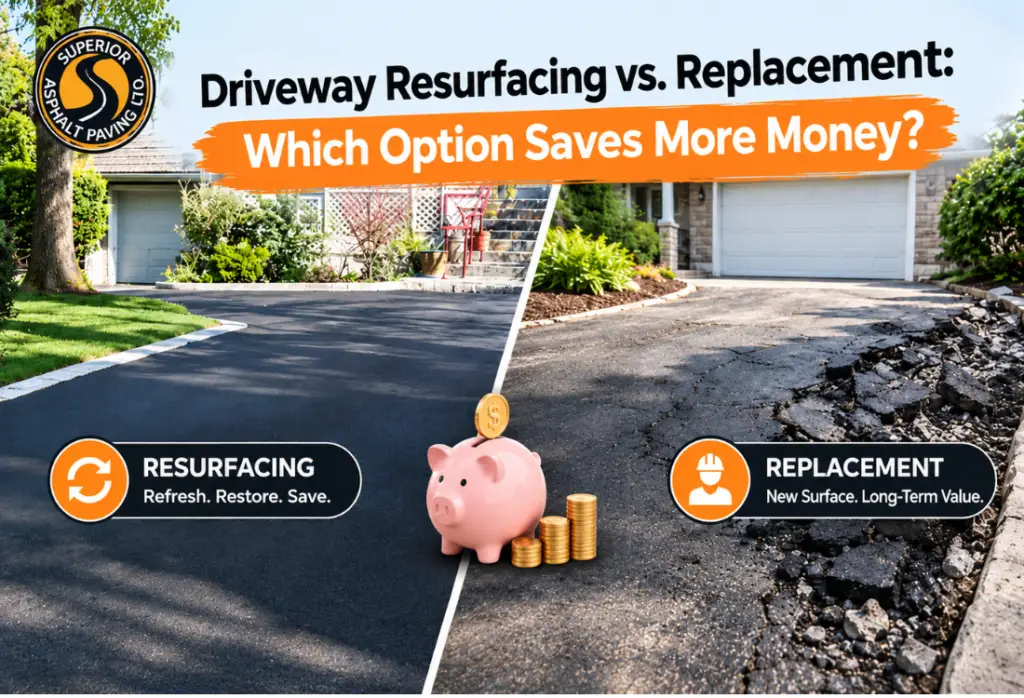
When your asphalt driveway starts showing cracks, fading, potholes, or uneven areas, one question usually comes first: Should you resurface the driveway or replace it completely?
The answer depends on the condition of your existing asphalt, the strength of the underlying base, the extent of the damage, and your long-term plans for the property.
In many cases, driveway resurfacing and replacement can both improve the appearance, performance, and value of your property. Resurfacing is generally the more affordable option when the existing driveway has a stable foundation and mostly surface-level damage. However, complete replacement can provide better long-term value when structural problems are already affecting the driveway.
For homeowners in the Lower Mainland, making the right decision is particularly important because rain, moisture, and seasonal temperature changes can contribute to asphalt deterioration.
What Is Driveway Resurfacing?
Driveway resurfacing involves preparing the existing asphalt and installing a new asphalt layer over it. Instead of removing the entire driveway, the existing pavement is repaired and prepared before the fresh asphalt surface is applied.
Resurfacing can be an effective solution when:
- The existing driveway has a solid, stable base
- Surface cracks are relatively minor
- The asphalt is worn or faded
- There are small areas of surface deterioration
- The driveway has lost its smooth appearance
- You want to improve curb appeal without the cost of complete replacement
Superior Asphalt Paving Ltd. offers standard resurfacing, mill-and-resurface services, and partial replacement options depending on the driveway’s condition.
Why Resurfacing Can Save Money
The biggest financial advantage of resurfacing is that it can avoid the extensive excavation, removal, and reconstruction required for a full replacement.
If the foundation underneath the asphalt is still performing properly, there may be no reason to remove everything. A properly prepared surface and new asphalt layer can restore the driveway while reducing the scope of the project.
This makes resurfacing an attractive option for homeowners who want to improve their driveway while keeping the project within a more manageable budget.
However, the affordable upfront option is not always the more affordable long-term option.
If serious structural damage exists underneath the surface, resurfacing may only temporarily hide the problem.
What Is Complete Driveway Replacement?
Complete driveway replacement involves removing the existing asphalt and rebuilding the driveway from the foundation upward.
Depending on site conditions, the process can include:
- Removing the existing asphalt
- Evaluating the underlying base
- Correcting drainage or grading issues
- Installing or rebuilding the supporting base
- Compacting the foundation
- Installing new asphalt
- Compacting and finishing the new surface
- Completing the edges and cleaning the property
Superior Asphalt Paving Ltd. describes complete replacement as the more comprehensive solution for severely damaged driveways
Replacement generally costs more initially than resurfacing because more materials, labour, preparation, and equipment are involved. However, it can be the better financial decision when the existing driveway has reached the end of its useful life.
Driveway Resurfacing vs. Replacement: Which Costs Less?
In general, resurfacing costs less upfront than complete replacement when the existing foundation is sound.
But cost should not be the only factor.
Consider this simple comparison:
| Factor | Driveway Resurfacing | Complete Replacement |
| Initial investment | Generally lower | Generally higher |
| Project scope | Surface-focused | Full reconstruction |
| Existing base | Must be structurally sound | Can be rebuilt |
| Severe cracking | May not be suitable | Usually better solution |
| Drainage problems | Limited correction | Can address underlying issues |
| Major structural damage | Not ideal | Recommended |
| Appearance | Like-new surface | Completely new driveway |
| Long-term value | Excellent when suitable | Better for severely damaged driveways |
The right choice depends on what is happening below the surface, not just what the driveway looks like from above.
When Is Resurfacing the More Affordable Choice?
Resurfacing can be the smarter financial decision when your driveway has cosmetic or moderate surface deterioration but the underlying structure remains strong.
For example, your driveway may be a good candidate for resurfacing if it has:
Minor Cracking
Small cracks can develop naturally over time. If the underlying pavement remains structurally sound, surface preparation and resurfacing may restore the driveway without requiring complete reconstruction.
Faded or Worn Asphalt
Sun exposure, traffic, weather, and age can cause asphalt to lose its original appearance. Resurfacing can provide a fresh, uniform surface.
Surface-Level Wear
If the driveway feels structurally stable but looks old and worn, resurfacing may provide a cost-effective improvement.
Localized Damage
Some driveways have isolated problem areas rather than widespread structural failure. Partial replacement or targeted repairs may also be considered before deciding on a complete replacement.
When Does Replacement Save More Money in the Long Run?
There are situations where choosing resurfacing simply because it costs less initially can result in higher expenses later.
Complete replacement may make more financial sense when you have:
Extensive Cracking
Large networks of cracks, deep cracks, or widespread deterioration can indicate that the problem is more than cosmetic.
Potholes and Severe Surface Failure
Repeated potholes can indicate deterioration beneath the surface. Repairing the same areas again and again can become expensive and frustrating.
Weak or Failing Base
The base provides critical structural support for asphalt. If the foundation has deteriorated, adding a new surface layer may not solve the underlying problem.
Drainage Problems
Water is one of the major concerns for asphalt pavement. If poor grading or drainage is contributing to deterioration, the problem should be addressed as part of a larger reconstruction rather than simply covered with new asphalt.
Major Uneven Areas
Significant sinking, shifting, or uneven sections can indicate problems underneath the existing asphalt. Replacement allows the contractor to address those underlying conditions.
Don’t Pay Twice for the Same Problem
One of the most important considerations when comparing driveway resurfacing and replacement is the difference between short-term savings and long-term value.
Imagine a driveway with significant base failure.
A homeowner might choose resurfacing because it appears less expensive. But if the underlying foundation continues to move or deteriorate, cracks and other problems can eventually return.
That means the homeowner may eventually pay for:
- Initial resurfacing
- Additional repairs
- More maintenance
- And eventually complete replacement
In this situation, replacing the driveway correctly the first time may provide better overall value.
On the other hand, if the existing foundation is strong, replacing the entire driveway unnecessarily can mean spending money on work that isn’t needed.
The goal isn’t simply to choose the lower cost service. It’s to choose the service that solves the actual problem.
How Long Does Resurfacing or Replacement Last?
The expected lifespan depends on installation quality, drainage, traffic, maintenance, climate, and the condition of the underlying base.
Superior Asphalt Paving Ltd. states that its resurfaced driveways can last approximately 15-20 years, while complete replacement can last approximately 20-30 years, depending on conditions and maintenance.
Proper maintenance also matters.
Regular crack repair and sealcoating can help protect asphalt from moisture and everyday wear. Superior Asphalt recommends sealcoating every 3-5 years as part of driveway maintenance.
What About the Lower Mainland Climate?
Homeowners in Vancouver, Surrey, Langley, Burnaby, Coquitlam, Richmond, and surrounding Lower Mainland communities need to consider local weather conditions when planning driveway work.
Frequent rainfall and moisture can affect pavement when water penetrates cracks or reaches vulnerable areas. Proper grading, drainage, surface preparation, asphalt installation, and compaction are therefore important parts of a durable driveway.
Superior Asphalt Paving Ltd. specifically provides driveway resurfacing and replacement throughout the Lower Mainland and recommends evaluating the driveway’s surface condition and base integrity before selecting a solution.
How Superior Asphalt Paving Ltd. Helps You Choose
Choosing between resurfacing and replacement shouldn’t be based solely on a quick visual inspection.
A professional assessment can consider:
- Existing asphalt condition
- Crack severity
- Potholes and damaged sections
- Base stability
- Drainage and grading
- Driveway slope
- Traffic and vehicle requirements
- Long-term property plans
- Potential maintenance requirements
Superior Asphalt Paving Ltd. provides an on-site driveway assessment and develops a solution based on the condition of the existing driveway. The company offers resurfacing, mill-and-resurface, partial replacement, and complete replacement services.
Why Choose Superior Asphalt Paving Ltd.?
Superior Asphalt Paving Ltd. has been serving customers since 1975 and reports completing more than 25,000 residential and commercial projects. The company also operates its own asphalt production plant and maintains its own equipment, helping it control production and project costs.
Homeowners can benefit from:
- More than 40 years of industry experience
- Residential driveway resurfacing and replacement
- In-house asphalt production
- Professional site preparation
- Written workmanship warranty
- Transparent project estimates
- Service throughout the Lower Mainland
- Experience with repairs, resurfacing, and complete driveway installation
The company’s driveway service page also states that most driveway projects can be completed within approximately 1-3 days, depending on the scope of work.
So, Which Option Saves More Money?
If your driveway has minor to moderate surface damage and a strong underlying base, resurfacing is usually the more economical choice.
If your driveway has severe cracking, extensive potholes, drainage problems, significant sinking, or a deteriorating foundation, complete replacement may provide better long-term value.
The most cost-effective solution is the one that addresses the root cause of the damage.
Rather than automatically choosing the lowest upfront price, have your driveway professionally assessed and compare the immediate cost with the expected lifespan, maintenance requirements, and potential future repair expenses.
Final Thoughts
Choosing between driveway resurfacing and replacement is ultimately a decision about value, not just price.
Resurfacing can give a structurally sound driveway a fresh appearance and extend its useful life while requiring less extensive work. Replacement costs more initially but can be the smarter investment when the existing pavement or foundation has significant structural problems.
For homeowners across the Lower Mainland, Superior Asphalt Paving Ltd. can assess your driveway and recommend whether resurfacing, partial replacement, or complete replacement makes the most sense for your property.
If you’re unsure which option is right for your driveway, get a professional assessment before committing to the project. The right solution can save you money today and potentially prevent much larger expenses in the future.
Ready to improve your driveway? Contact Superior Asphalt Paving Ltd. for a professional assessment and free quote.