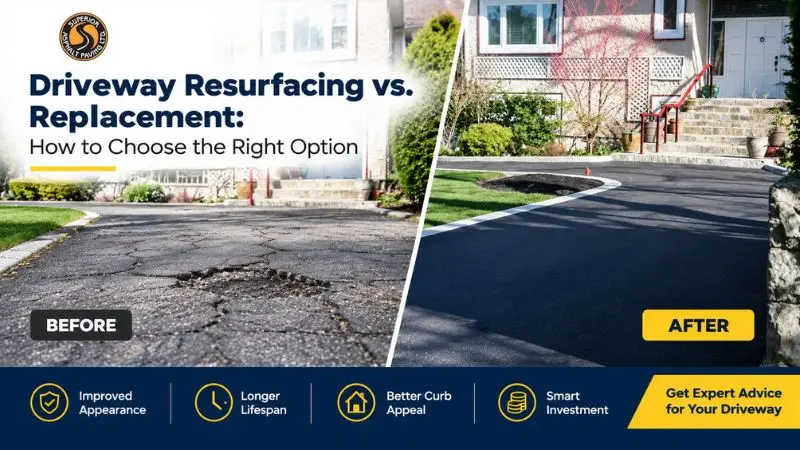
Your driveway plays an important role in your home’s appearance, accessibility, and overall value. However, years of vehicle traffic, heavy rainfall, changing temperatures, and everyday wear can gradually damage an asphalt surface. When cracks, potholes, fading, or uneven areas appear, many homeowners face an important question: should you invest in driveway resurfacing or choose complete replacement?
The right decision depends on more than the appearance of your driveway. You also need to consider the condition of the existing asphalt, the stability of the underlying base, drainage, and the extent of the damage.
For homeowners across the Lower Mainland, understanding these differences can help prevent unnecessary expenses and support a longer-lasting paving solution.
In this guide, Superior Asphalt Paving Ltd. explains how driveway resurfacing and replacement work, when each option makes sense, what affects the cost, and how to choose the right solution for your property.
What Is Driveway Resurfacing?
Driveway resurfacing involves applying a new layer of asphalt over an existing driveway after preparing the surface and addressing suitable defects. Rather than removing the entire driveway, contractors preserve the existing pavement and renew its upper layer.
This approach can restore a worn driveway’s appearance while extending its useful life. However, resurfacing works best when the existing pavement and underlying base remain structurally sound.
Before applying new asphalt, a paving contractor should inspect the driveway, repair suitable damaged areas, prepare the surface, and evaluate drainage and elevations.
When Should You Resurface an Asphalt Driveway?
Driveway resurfacing may be a suitable option when:
- The surface looks faded, worn, or weathered.
- Minor cracks appear in isolated areas.
- The existing asphalt remains stable.
- The underlying base shows no significant signs of failure.
- The driveway drains properly without persistent standing water.
- Previous repairs have not repeatedly failed because of structural problems.
For example, an older driveway may look unattractive despite having a solid foundation. In this situation, resurfacing may provide a practical way to improve its appearance without the expense of removing and rebuilding the entire pavement.
Nevertheless, a professional assessment is essential before choosing an overlay. A new asphalt layer cannot reliably correct a failing base or an unresolved drainage problem.
What Is Driveway Replacement?
Driveway replacement involves removing the existing asphalt and rebuilding the driveway. Depending on the property’s condition, the contractor may also excavate unsuitable material, repair the base, improve drainage, and install new asphalt.
Although replacement generally requires more preparation than resurfacing, it allows contractors to address problems beneath the visible surface.
When Does Your Driveway Need Complete Replacement?
Full replacement may be the better option when:
- Large areas show interconnected or alligator-pattern cracking.
- Sections of the driveway have sunk or shifted.
- The underlying base has deteriorated or lost stability.
- Potholes continue returning after repairs.
- Water collects because of significant grading or drainage problems.
- The existing asphalt has deteriorated extensively.
- The driveway needs substantial changes to its layout or elevation.
For instance, if a section repeatedly sinks because the underlying base has failed, adding another asphalt layer will not solve the underlying problem. Instead, the contractor may need to remove the affected pavement and rebuild the foundation.
Similarly, extensive cracking across several areas may indicate that the damage extends beyond the surface. In these circumstances, complete replacement can provide a more appropriate long-term solution.
Driveway Resurfacing vs. Replacement: Key Differences
Both options can improve an asphalt driveway, but they differ in preparation, scope, cost, and suitability.
| Comparison factor | Driveway resurfacing | Complete driveway replacement |
| Main process | Prepares the existing pavement and adds a new asphalt layer | Removes existing pavement and rebuilds the driveway |
| Existing base | Must remain sufficiently stable | Can be repaired or rebuilt where necessary |
| Best suited for | Surface wear and suitable minor defects | Extensive damage or underlying structural problems |
| Initial investment | Generally lower when the existing pavement is suitable | Generally higher because of removal and reconstruction |
| Project complexity | Usually less extensive | Usually involves more preparation and construction |
| Drainage corrections | Limited if major grading changes are required | Offers more opportunity to correct underlying grading issues |
| Long-term value | Strong when the existing foundation remains sound | May provide better value when resurfacing would only postpone necessary reconstruction |
Ultimately, neither option is automatically the best choice for every property. A contractor should evaluate the driveway’s actual condition before recommending a solution.
Driveway Resurfacing vs. Replacement: Which Costs Less?
For many homeowners, cost is one of the most important factors when choosing between resurfacing and replacement.
In general, resurfacing costs less upfront because the contractor retains the existing pavement instead of removing and rebuilding the entire driveway. However, the actual price depends on the amount of preparation required and the condition of the existing surface.
Full replacement typically involves additional work, including asphalt removal, disposal or recycling, base preparation, compaction, and new asphalt installation. As a result, the initial investment may be higher.
What Affects Driveway Resurfacing Costs?
Several factors influence the cost of resurfacing, including:
- Driveway size: Larger surfaces require more asphalt and labour.
- Surface preparation: Cleaning, crack treatment, and localized repairs can affect the total price.
- Asphalt thickness: The required overlay thickness depends on the existing pavement and project specifications.
- Access conditions: Limited access or difficult site conditions may increase labour requirements.
- Drainage and elevations: Existing slopes, garage entrances, and adjoining surfaces can affect the work required.
What Affects Driveway Replacement Costs?
Complete replacement may involve additional expenses for:
- Removing and disposing of existing asphalt.
- Excavating unstable or unsuitable material.
- Supplying and compacting new base materials.
- Correcting drainage and grading issues.
- Installing and compacting new asphalt.
- Adjusting driveway edges and connections to surrounding surfaces.
Although resurfacing may offer a lower initial price, it is not always the most economical option over time. If the underlying base has failed, a new overlay may deteriorate prematurely and require further investment.
Therefore, compare written estimates based on the recommended work, materials, preparation, and warranty rather than choosing a contractor solely by the lowest price.
How to Decide: 5 Warning Signs Your Driveway Needs Attention
Recognizing early signs of deterioration can help you determine when to arrange a professional driveway inspection.
1. Widespread Cracking
Small, isolated cracks may be manageable with appropriate repairs. However, extensive interconnected cracks can indicate deeper pavement or base problems.
If cracks continue spreading across large sections of your driveway, ask a paving contractor to assess the underlying structure before recommending resurfacing.
2. Recurring Potholes
Potholes often develop when water enters damaged asphalt and weakens the pavement or its supporting layers. Vehicle traffic can then accelerate the deterioration.
Although contractors can repair isolated potholes, repeated failures in the same areas may indicate a more significant problem. In such cases, the contractor should investigate the cause rather than simply patching the surface again.
3. Sinking or Uneven Sections
A driveway that develops dips, depressions, or sunken areas may have an unstable base or settlement issues.
Adding new asphalt over these areas will not necessarily correct the underlying movement. Instead, a contractor should determine whether localized reconstruction or complete replacement is appropriate.
4. Persistent Standing Water
After heavy rainfall, check whether water collects in specific areas of your driveway.
Standing water may indicate poor drainage, an unsuitable slope, or surface depressions. Because moisture can contribute to asphalt deterioration and weaken the supporting base, resolving the cause is important before resurfacing.
5. Repeated Repair Problems
Have you repaired the same cracks, potholes, or damaged sections several times? If so, the original problem may extend beneath the surface.
Consequently, another repair or overlay may offer only temporary improvement. A professional assessment can help determine whether targeted repairs, resurfacing, or complete replacement offers better long-term value.
How Lower Mainland Weather Affects Your Asphalt Driveway
Homeowners across Vancouver, Surrey, Langley, Burnaby, Richmond, and surrounding Lower Mainland communities must consider local weather and drainage when maintaining asphalt driveways.
Frequent rainfall can allow water to enter cracks and damaged areas. If moisture reaches the supporting base, it may weaken the foundation and contribute to settlement, potholes, and further deterioration.
In addition, changing temperatures and repeated wetting and drying can place stress on an already damaged driveway. Poor drainage, inadequate compaction, and heavy vehicle loads may increase these risks.
To help protect your driveway:
- Address significant cracks before water infiltration causes further damage.
- Keep drainage routes clear and monitor areas where water collects.
- Avoid allowing recurring potholes or depressions to remain untreated.
- Arrange professional inspections when cracks spread or sections begin to sink.
- Follow your paving contractor’s maintenance recommendations after resurfacing or replacement.
Most importantly, do not assume that a new asphalt layer will correct every weather-related problem. Proper surface preparation, a stable base, suitable grading, and effective drainage all contribute to long-term pavement performance.
How to Choose a Reliable Driveway Paving Contractor
Whether you choose driveway resurfacing or complete replacement, the contractor you hire can significantly influence the quality and durability of the finished work.
Before requesting an estimate, consider the following factors.
1. Experience With Asphalt Driveways
Choose a contractor with relevant experience in residential asphalt paving. Experienced professionals can evaluate different types of pavement damage and recommend a solution that suits your property’s needs.
2. A Thorough Site Assessment
A reliable contractor should inspect the existing driveway, assess the base where possible, identify drainage concerns, and explain why resurfacing or replacement makes sense.
Avoid relying on a recommendation based solely on photographs when significant structural concerns require an on-site assessment.
3. A Clear Written Estimate
Your estimate should explain the project scope, surface preparation, materials, removal or repair requirements, expected timeline, and warranty coverage.
Additionally, ask whether the quote includes disposal, base repairs, grading adjustments, and cleanup. Understanding these details makes it easier to compare contractors fairly.
4. Quality Materials and Proper Installation
The quality of the asphalt matters, but so does the installation process. Proper preparation, appropriate material placement, and effective compaction help create a durable finished surface.
Ask your contractor how the proposed work will address your driveway’s specific conditions.
5. Written Warranty and Accountability
Before work begins, review the warranty terms and confirm what the contractor covers. A written warranty provides clarity about the company’s responsibilities after installation.
Choosing a contractor who explains the work clearly can help you make a more informed decision and avoid unexpected issues.
Why Choose Superior Asphalt Paving Ltd.?
Superior Asphalt Paving Ltd. is a family-owned and operated asphalt paving company serving the Lower Mainland since 1975. We help homeowners improve their properties with professional asphalt paving, driveway repairs, resurfacing, and replacement services.
Our approach focuses on understanding each property’s requirements and recommending suitable paving solutions.
Here is what sets our company apart:
- Decades of experience: Our team brings extensive experience in residential asphalt paving throughout the Lower Mainland.
- On-site asphalt manufacturing: We manufacture our own asphalt, giving us greater control over material production and project coordination.
- Written warranty: Our driveway resurfacing and replacement projects include a one-year written warranty covering workmanship and materials, subject to the applicable terms.
- Professional installation: We focus on appropriate preparation, asphalt placement, compaction, and finishing.
- Local service: We serve homeowners in Vancouver, Surrey, Langley, Burnaby, Richmond, Delta, White Rock, and other Lower Mainland communities.
Most importantly, we understand that every driveway has different requirements. Our team assesses the existing pavement and helps homeowners determine whether resurfacing, localized repairs, or complete replacement is the most appropriate option.
Learn more about our Driveway Resurfacing & Replacement services or contact Superior Asphalt Paving Ltd. to request a quote for your property.
Frequently Asked Questions
1. Is driveway resurfacing better than replacement?
Driveway resurfacing is often suitable when the existing asphalt and base remain stable and the main problem involves surface wear. However, complete replacement may be necessary when the pavement has widespread structural damage, significant settlement, or serious base problems. A professional inspection can help determine the right option.
2. How do I know if my asphalt driveway needs replacement?
Look for widespread interconnected cracks, recurring potholes, sinking sections, persistent drainage problems, and repeated repair failures. These symptoms may indicate underlying structural damage. However, a paving contractor should inspect the driveway before recommending complete replacement.
3. Is resurfacing cheaper than replacing a driveway?
Resurfacing generally costs less upfront because it avoids full pavement removal and reconstruction. Nevertheless, costs vary according to driveway size, surface preparation, asphalt requirements, and site conditions. If the underlying base has failed, replacement may offer better long-term value.
4. How long does driveway resurfacing or replacement take?
The timeline depends on driveway size, site access, weather, preparation requirements, and the extent of the work. Smaller residential projects may take a few days, while larger or more complex projects can take longer. Your contractor should provide a project-specific schedule and explain when you can safely use the driveway.
5. Can you resurface an asphalt driveway with cracks?
Yes, provided the cracks are suitable for treatment and the underlying pavement remains stable. However, widespread interconnected cracking, significant movement, and recurring failures may indicate deeper problems that an overlay cannot resolve. Contractors should assess the damage before proceeding.
6. How does rain affect asphalt driveway resurfacing?
Rain can interfere with surface preparation, asphalt placement, and compaction. In addition, water trapped beneath the pavement may weaken the base. Contractors should assess site and weather conditions before scheduling work to help ensure proper installation.
7. Does Superior Asphalt Paving provide driveway resurfacing and replacement in the Lower Mainland?
Yes. Superior Asphalt Paving Ltd. provides residential driveway resurfacing, replacement, and related asphalt paving services throughout the Lower Mainland. Contact our team to discuss your driveway’s condition and request a quote.
Final Thoughts
Choosing between driveway resurfacing and replacement starts with understanding what is causing the damage. If your asphalt surface looks worn but the supporting base remains stable, resurfacing may offer a practical and cost-effective solution. Conversely, widespread cracking, sinking, recurring potholes, and underlying base failure may call for complete replacement.
Rather than choosing based on appearance or upfront price alone, consider the driveway’s structural condition, drainage, preparation requirements, and long-term maintenance needs.
Superior Asphalt Paving Ltd. has served Lower Mainland homeowners since 1975. If your driveway needs attention, our team can help you evaluate the available options and plan the next steps.
Ready to improve your driveway? Visit our Driveway Resurfacing & Replacement service page or contact Superior Asphalt Paving Ltd. to request your quote.